I read a McKinsey piece recently called "The Judgment Bottleneck," and I haven't been able to put it down. The premise is simple. Analysis now runs on AI time. Judgment still runs on human time. The gap between those two clocks is where a lot of organizations are about to get hurt.
One idea in it is foundational. Every system is ultimately limited by its most constraining step.
Let me tell you, that isn't new. Anyone who has run a production line, managed a sales pipeline, or sat through a budget cycle knows it. Make one step ten times faster, and if the next step can't absorb it, all you've done is build a bigger pile in front of the bottleneck. I describe Capacity as a river, not a container. You can pour more water in upstream all day long. If the channel downstream can't carry it, the river floods.
With AI, the constraint has moved. It isn't the analysis anymore. It's us. It's the leader who has to understand the implications, challenge the assumptions, weigh the trade-offs, and own the call.
Here's the part most people miss. That bottleneck isn't a bug. It's the point.
Technology is a multiplier, not a substitute
In the 10X Doctrine, Organizational Capacity is (Leadership + People + Process) x Technology. Technology sits outside the parentheses on purpose. It doesn't create Capacity. It multiplies whatever is already there. Sound Leadership, capable and willing People, and a sound Process get amplified. Weak ones get weaker, faster. Misapplied, technology can invert the whole thing.
AI is the most powerful multiplier most of us will ever get our hands on. That cuts both ways.
The McKinsey authors describe a junior team that started producing analysis 10 to 20 times faster and running three to five times as many scenarios. Sounds like a win. But the executives reviewing that work slowed down, because they couldn't tell which assumptions and data sources sat behind the outputs. They used to know their analysts and which calls each one could be trusted with. Now they had a black box, so they had to check everything.
There's your 10X. And it made the decision slower.
That's what happens when Technology gets multiplied against a Leadership step that was never rebuilt to handle it. The channel didn't get any wider. More water just showed up.
Exhibit: Two paths for AI · speed only vs. slow is fast
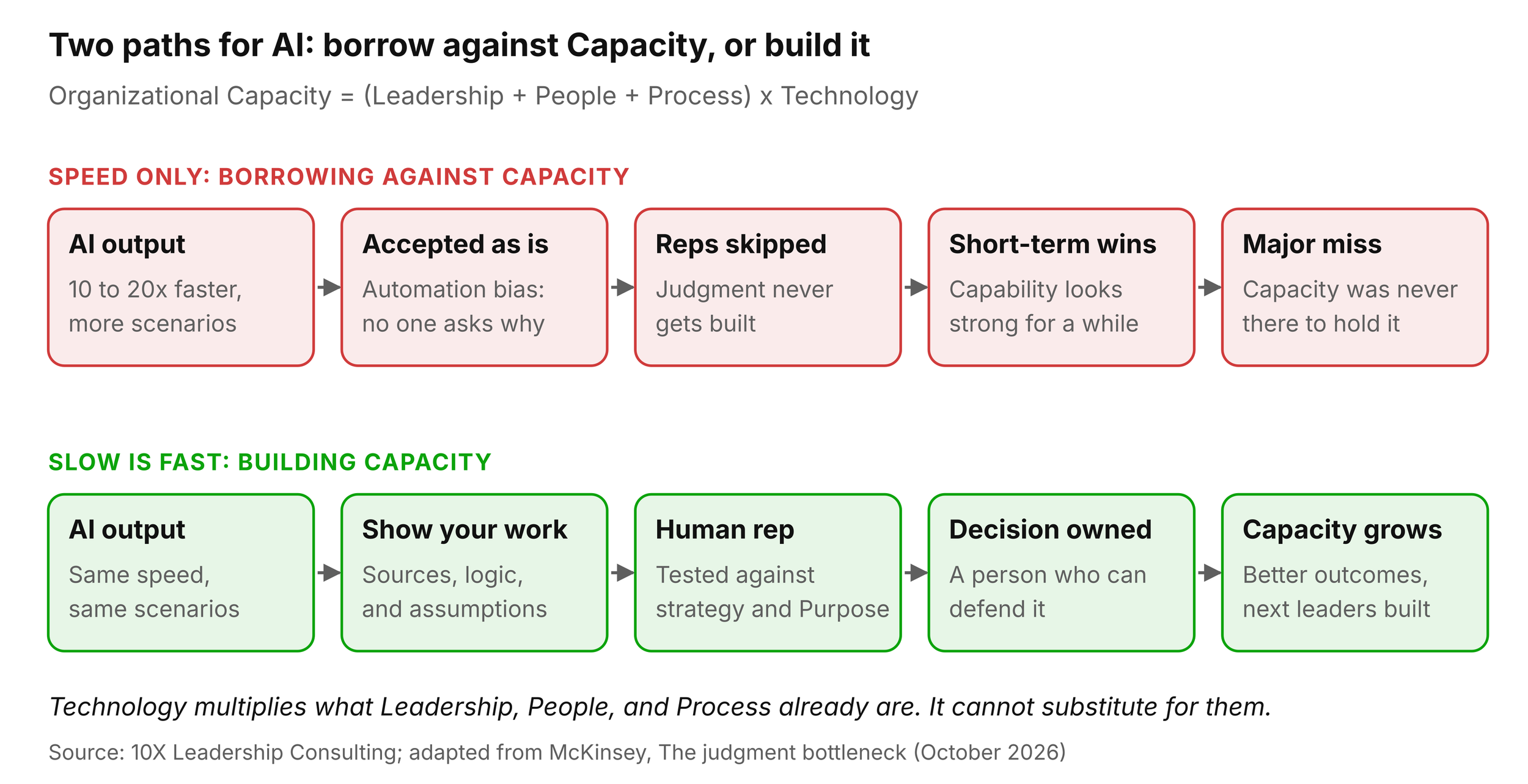
The exhibit lays out the choice every organization is making right now, whether it's being deliberate about it or not. Both paths start with the same AI output at the same speed. What happens in the next step decides whether you're building Capacity or borrowing against it.
The goal is better outcomes, not just efficiency
The goal of AI shouldn't be solely efficiency. It should be better outcomes.
Most organizations look at AI through an efficiency lens because efficiency is easy to see. One executive in the article said his team now finishes five weeks of financial analysis in under two days. That shows up on a slide. A bad assumption that never got challenged doesn't show up anywhere. Not until it does.
The Doctrine is precise on this. Performance is measured against Purpose, not activity. More output is not progress. More scenarios are not better Judgment. And Judgment has a definition: weighing a specific situation against Purpose, informed by the organization's real Capacity, Condition, Capability, and Performance. A leader who signs off on an AI recommendation without understanding what's underneath it isn't exercising Judgment. They're guessing. It's a guess wearing the clothes of a decision, and the confidence of the machine doesn't change what it is.
Judgment is built on old-school reps
You don't get strong watching somebody else lift.
Most of the leaders I know built their judgment the hard way. They built the model by hand. They got the assumptions wrong. A senior manager red-lined the deck and asked a question they couldn't answer, and they never forgot it. Those were the reps. Low-stakes mistakes and real feedback, over and over, until the pattern recognition was in their bones.
AI is taking those reps away. The article quotes a business unit leader who used to ask junior analysts basic questions, like whether a model used nominal GDP or whether goodwill was in the calculation. Now people don't know. That's the basic stuff. Forget the deeper assumptions behind the scenarios.
Here's the paradox. AI produces more work that requires judgment while removing the very work that builds it.
So how do we keep "old school" tasks in the mix while acquiring technology at speed and scale? That's an individual question for every company and organization. There's no one right answer. But there must be deliberate thought given to it, and then consistent action behind it. Both. Judgment that never becomes a Decision doesn't do anything. It stays a private conclusion in somebody's head while the organization absorbs the cost.
Without that, the leadership pipeline gets cut off. Not this quarter. Maybe not this year. But it gets cut off. And the competitors who were intentional about it will take market share, because they kept cultivating the Capacity of the organization while everyone else was celebrating throughput.
This is a Stewardship question. In the Doctrine, Stewardship means exercising authority as accountable to something beyond yourself, with the obligation to leave what you lead in a better state than you received it. When it comes to the organizations we have the privilege to lead, that has to be at the forefront. Capacity should always be a primary consideration, not just speed. Choosing speed today at the expense of the next generation of leaders is the little "i" winning at the expense of the Big "I." It just doesn't look like it yet.
Make the AI slow down and show its work
Part of the solution may be to slow AI down some. Require it to interact with a human before its work moves forward. Make it show the sources it used and why. Make it surface the assumptions it made and the logic behind its analysis. Then require the person who owns that work to understand it well enough to defend it.
One organization in the article does a version of this. Teams have the tool lay out the formulas, data, calculations, and assumptions behind each step, and team members are expected to answer questions about it. That's a rep. That's judgment being built on purpose.
Why does it matter? Because the AI may have made a wrong assumption. Or it may be perfectly logical and completely misaligned with the strategic direction the leadership team talked through in a meeting last Tuesday that hasn't made it into a document yet. The model can't know what was said in the room. A person who was in the room can.
To be clear, the answer is not abandoning AI. And it is not trusting AI decisions 100 percent. The answer lies somewhere in the messy middle. That's where the hard work is, and that's where the advantage is.
Automation bias and the Deepwater Horizon lesson
Automation bias is the tendency to trust an output simply because a machine produced it. It directly conflicts with long-term Capacity, because every time a person accepts an answer they didn't interrogate, they skip a rep. Pair it with confirmation bias, trusting the answer because it tells us what we already wanted to hear, and you have a dangerous combination.
Companies that lean into it will probably jump out ahead of their peers. They'll see a lot of short-term wins. Faster cycles. Leaner teams. Great dashboards. But it won't last. At some point the bias will overlook a major issue, and the outcome won't be small.
Think about the BP Deepwater Horizon disaster in the Gulf of Mexico in April 2010.
The presidential commission that investigated it found that BP, Halliburton, and Transocean made a series of decisions that saved time and money but increased the risk of a blowout. Of the nine critical decisions the commission laid out, seven saved time. The rig reportedly cost around a million dollars a day to operate. Every day mattered, and the pressure was to move.
Then came the negative pressure test, the check meant to confirm the cement seal at the bottom of the well was holding. The readings showed a problem. Pressure kept building back up. The crew ran an alternative test on a different line, got a reading they liked, and judged the whole thing a success. The commission found there were no real procedures for interpreting that test, and the people interpreting it hadn't been formally trained to do it. Investigators also noted that a knowledgeable engineer was visiting the rig, and nobody asked him about the unexpected results.
Read that again. The instrument told them something was wrong. They picked the reading that agreed with where they wanted to go. The judgment was in the building, and nobody asked for it.
Eleven people died. Oil flowed into the Gulf for 87 days. BP's total bill for cleanup, fines, and penalties eventually came to roughly $65 billion.
Deepwater Horizon wasn't an AI failure. But it's the exact pattern. Speed pressure. A process with no clear standard for interpreting the data. People who didn't have the reps to know what they were looking at. And a reading accepted because it said what everyone hoped it would say. Capability looked strong right up until the moment it didn't. Not everything that glitters is gold, and Capability is not Capacity.
Go back to the exhibit. That's the top row, played out in the real world, with real lives on the line.
Now picture that same dynamic with an AI model producing hundreds of outputs a week, reviewed by people who were never given the chance to build the judgment to question them. Small foxes spoil the vine. The skipped check. The assumption nobody asked about. The scenario everybody accepted because it looked clean. They don't announce themselves. They accumulate.
Slow is fast
There's a phrase that came out of military circles: slow is smooth, and smooth is fast. I shorten it. Slow is fast.
It doesn't mean be slow. It means the deliberate step you're tempted to skip is usually the one that keeps you from doing the whole thing over, or from doing something you can't undo.
So stop asking, "How fast can AI get us there?" Start asking, "How much Capacity are we building while we go?" Where are our people still getting reps? Which decisions do we deliberately slow down? Who owns the output, and can they defend it?
Everything rises and falls on leadership. AI doesn't change that. It just raises the stakes.
Reference: Alex D'Amico, Bruce Delteil, Laura LaBerge, and Matt Banholzer, "The judgment bottleneck: Balancing AI and human speeds in strategy," McKinsey & Company, October 2026.